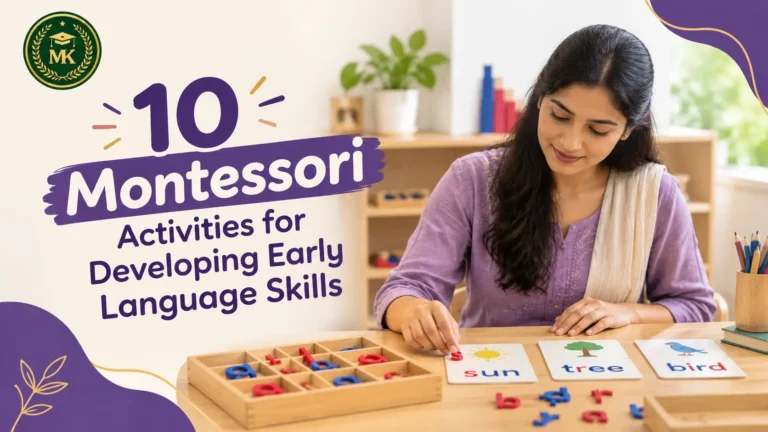
10 Montessori Activities For Developing Early Language Skills
Through the Montessori way of teaching, children learn language in a very practical and fun way that helps them remember and integrate the language in their life. In Montessori teaching, the lessons all align with a child’s developmental age. The concepts are introduced in colourful and creative ways that naturally make them curious and motivate the children to explore the language.
In Montessori teaching methods, the languages are taught in a multi-sensory way. They do not just look at a letter; they hear its sound, see its shape, and feel its texture. It makes language memorable to them. It helps them to speak, write, and read.
Here are 10 Montessori activities that are practiced to develop children's language skills
1) Three Period Lesson:
This method has three steps that are created to introduce new vocabulary and concepts to the child. In this method, a new name of an object or colour is introduced to the child; after that, the child is encouraged to recall the name of the object without pressure.
The teacher introduces an object or name and clearly states its name. Through this method, the child sees the physical object and identifies the object with the name. Then, in the second step, the teacher says the name of the object, and the child has to identify, pinpoint, or show the object.
Then, in the last step, the teacher asks the child what’s this ? by showing the object, and the child is encouraged to say the name of the object.
This method helps develop children’s vocabulary, listening, comprehension, and speaking skills.
2) First Object Box:
A First Object Box contains small objects with simple phonetic names, such as a hat, bat, or cup. The child identifies each object and matches it with its written label. With guidance suited to their learning stage, children can sound out the letters and begin reading simple words.
This activity supports vocabulary development, phonetic awareness, and early reading skills.
3) Language Basket:
A small basket is filled with real, everyday objects belonging to the same category, such as fruits, vegetables, or animals.
For example, you can fill the basket with five different types of fruit. Introduce one fruit at a time by clearly saying its name. Then, hand the fruit to the child and allow them to explore it by looking at, smelling, and touching it. Once the child has finished exploring the fruit, move on to the next one.
This activity helps children learn new words through sensory experiences and develop their vocabulary by connecting words with real objects.
Kids learn fast when they experience learn things by touching them and seeing them in real life.
4) Picture to Picture Matching:
This learning activity teaches the child to notice similarities and differences between the objects.
- You need two sets of the same pictures. For example, you can use two pictures each of a car, a bike, or a bicycle. Select pictures of any five objects.
- Lay out the first set of pictures on the floor. As you place each picture, say the name of the object.
- Give the child the second set of pictures and ask them to match each picture with the identical one on the floor. Alternatively, you can hold the second set of pictures and ask the child to find the matching pictures.
- Repeat until every card is matched.
5) Nomenclature Cards:
For each object, there are three types of cards.
Example: Apple
- Control Card: A card with a picture and the printed word at the bottom, such as a picture of an apple with the word “apple.”
- Picture Card: A card with only a picture of the apple.
- Label Card: A small strip with only the printed word “apple.”
- First, the child picks up and places all the picture cards in a row.
- Then, the child takes the label cards, reads the words, and tries to match each label with the correct picture card.
- Finally, the child takes the control cards (pictures and words) and places them next to the matching picture cards. The child is encouraged to compare the words on the control cards with the labels they have matched.
6) Storytelling & Rhymes:
In Montessori language activities, oral language is developed through storytelling, rhymes, and active participation. The stories introduced to children often include real-life situations and experiences. Teachers encourage children to tell short stories about their own experiences or topics of interest. This helps build their communication skills and confidence.
Rhymes and songs are taught slowly and clearly, helping children recognise rhyming words and phonetic patterns. They are often accompanied by hand actions and whole-body movements.
7) Sandpaper:
Sandpaper letters are tactile letters mounted on smooth boards. Children trace each letter with their fingers while the teacher introduces its corresponding sound.
This multisensory activity helps children recognise letter shapes, connect letters with sounds, and develop the hand movements needed for early writing.
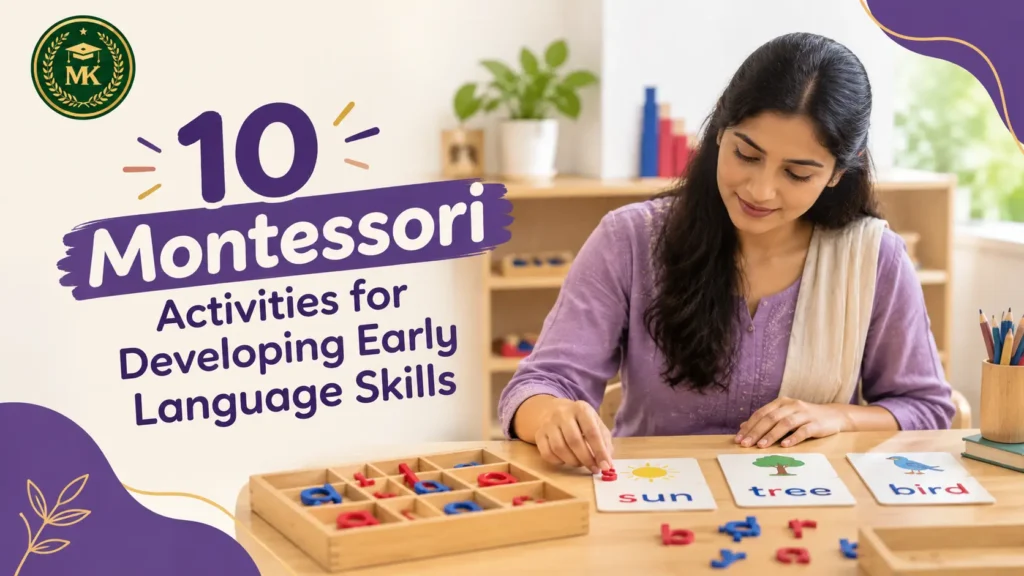
8) Movable Alphabets:
The box is filled with wooden alphabets which are colour-coded. Vowels are blue, while consonants are pink or red. The box has small compartments, and letters are arranged in alphabetic order.
Movable alphabets are paired with pictures or objects.
For Example: When the teacher says a word, the child is encouraged to break it down into individual sounds. The child then finds the letters that correspond to those sounds in the box and arranges them to spell the word.
This activity helps children develop phonetic awareness and early writing skills by connecting the sounds they hear with the letters they use to form words.
9) Sound games:
Sound games taught in the Montessori classroom help children develop their phonetic awareness. Children participate in rhymes, I Spy games, and songs.
In I Spy games, a tray is filled with pictures or objects. The teacher says the beginning sound of an object’s name, and the children identify the picture or object that matches that sound.
10) Practical Activities:
Kids are encouraged to engage in real-life activities that help them develop control of movements, discipline, and grace. Examples include pouring water into a glass, arranging objects, and cleaning their own belongings.
These activities help children develop practical life skills, language skills, and social skills.
MK Educational Academy Montessori Lab Facilities:
- If you want to learn Montessori teaching methods or earn a Montessori certification, you can choose MK Educational Academy, which offers well-equipped lab facilities for Montessori teacher training and teaches you how to arrange a Montessori classroom.
- Through the course, you will learn the foundations of Montessori education and how to use practical lab materials for various Montessori language activities.
- The academy places strong emphasis on practical teaching, helping future educators become classroom-ready.
- The training lab is well-maintained and equipped with materials aligned with Montessori classroom standards.
- The academy provides a friendly and encouraging learning environment for aspiring Montessori educators.
Frequently Asked Questions
Through movable alphabets, the phonics and letters are spelled out loud, and kids fetch the matching letter. It improves their listening and phonics skills.
Children are encouraged to make mistakes and explore on their own.
Alphabets are introduced through a sandpaper method, with colorful letters, and also the children touch the letters. This makes them remember the alphabets.
Through Montessori Activities concepts are introduced that are aligned with kids' age . Children learn all the things through exploring and experience without the pressure.
The classes are well maintained and will be child friendly. The classroom has small chairs, low open shelves, natural lighting, soft colors, and is organized. It also has materials for practical learning.
You can introduce the alphabet through the sandpaper method. You can also teach kids through the Three-Period Lesson, the first object box, the language basket, and encourage oral language development through storytelling.
Conclusion:
Through early-years Montessori education, children learn language in a practical and engaging way. When they touch objects, listen to sounds and words, speak, or narrate short stories, they expand their understanding of the world and naturally integrate language into their daily lives.
Through these Montessori activities, children can develop their language skills and vocabulary. The Montessori teaching method introduces language concepts in ways that are appropriate for their developmental stage and learning needs.