Principles of Montessori Method
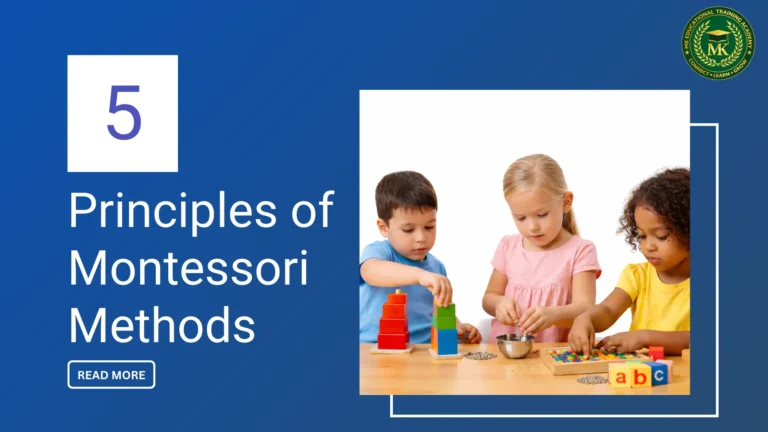
In today’s modern era, as education becomes a global importance students should not be forced to memorize concepts from their early kindergarten years. Rather, learning should focus on nurturing curiosity, creativity, and independent thinking from an early age.
Children learn the best when they explore, engage with their environment, and develop understanding using practical experiences rather than mechanical memorization.
This Montessori method of teaching demonstrates the philosophy, giving importance to self learning in a designed classroom, that encourages experimental learning. While educators support and monitor instead of dictating, facilitating each child to grow at their own tempo.
Today, Montessori education continues to grow, incorporating modern tools and equitable practices while maintaining its core principles of independence, curiosity, and holistic development.
In this blog, we will explore the 5 basic principles of Montessori Methods for Teaching, that describe how children can learn independently, stay curious, and enjoy learning.
What is Montessori Education?
Before we understand what are the core principles of the Montessori Method, we must know what Montessori Education is.
Montessori education is a way of teaching, that focuses on the child as an individual learner. Children learn by exploring, doing activities, and discovering things on their own. Teachers guide and support rather than give direct instructions. This approach helps the kids to become independent, curious, and confident learners.
Montessori Principles:
1) Respect for the Children:
Respect for the child means treating every child as a capable and unique individual. Teachers listen, observe, and support rather than control or force to learn. This helps younger minds feel valued, confident, and motivated to discover and learn on their own.
2) The Absorbent Mind:
The Absorbent Mind means young children automatically take in knowledge from everything around them. They learn quickly by listening, observing, and engaging with their environment.
During these early years, their minds grasp social skills, language and practical knowledge easily. Montessori education uses this stage to provide experiences, that help the children to learn spontaneously and enjoyably.
3) Sensitive Periods:
Sensitive periods are special times in a child’s life when they are very interested in learning certain skills or ideas. During these times, they can learn easily from what they see and experience around them.
When educators understand and guide these moments, it helps the children to progress in areas for example movement, language, habits, and social skills.
4) Prepared Environment:
A prepared environment in Montessori principles is a properly organized area curated to support a child’s independence and learning. It consists of simple, handy materials arranged in a structured way, so children can choose and use them on their own.
This environment helps the children to develop concentration, confidence, and responsibility, while experiencing and learning at their own tempo.
5) Auto-education :
Auto education in Montessori principles means, that children learn by themselves with the help of their own experiences, mistakes, and successes. When provided with a designed learning environment and stimulating materials, they automatically examine, experiment, and understand concepts at their own pace.
This self-directed learning encourages independence, critical thinking, problem-solving, and a lasting love for learning, while also helping children develop confidence and responsibility for their own education.
Frequently Asked Questions
Montessori learning lets younger minds choose activities and learn through experience, rather than following a structured curriculum. It motivates interest, self learning, by using applied skills, at the same time traditional methods concentrate on memorization and lectures.
Final Thoughts:
In conclusion, the Montessori Learning method highlights independence, self-directed learning, and hands-on experiences. By recognizing sensitive periods, preparing the environment, and supporting auto-education, children develop confidence, curiosity, and practical skills. Montessori education nurtures the whole child, helping them to grow academically, socially, and emotionally.
To learn more about this innovative approach and become skilled in Montessori teaching, you can enroll in MK Educational Training Academy, where expert guidance and practical training equip you to implement these principles easily.