Difference Between Montessori and Kindergarten
In today’s fast growing world, choosing the right early education method is a major decision for every parent. Montessori and kindergarten stand out for their unique teaching styles and learning environments among the most popular options.
While both aim to support a child’s growth and development, they differ clearly in structure, philosophy, and classroom experience. By understanding these differences it helps the parents to make better decisions for their child’s future.
In this blog, we will understand the difference between Montessori and kindergarten in detail. We will look at their teaching methods, curriculum structure, classroom setup, and the role of teachers in each system.
You will also learn about the primary benefits of both approaches and how they impact a child’s learning and independence, that helps you to decide which option best suits your children’s needs.
What is Montessori Method:
The Montessori method is an educational approach developed by Maria Montessori, that focuses on child driven learning. This method strengthens children to learn at their own pace through practical activities and self-directed exploration. It improves self reliance, interest, & essential life skills at an early age.
Pros:
- Promotes independence and self-learning
- Hands-on, practical learning approach
- Builds confidence and decision-making skills
- Supports individual learning pace
Cons:
- Less focus on structured academics
- Can be expensive in many schools
- Not always suitable for all learning styles
What is the Kindergarten Method ?
The Kindergarten Method is an early childhood education approach that highlights learning via play, creativity, and practical activities. It motivates children to discover concepts using games, songs, storytelling, and interaction rather than formal instruction. This method targets to develop a child’s social, emotional, and analytical skills in a natural and enjoyable way.
Pros:
- Stimulates creativity and imagination
- Turns learning fun and engaging
- Supports social and emotional development
- Helps children learn at their own pace
Cons:
- May not have a clear academic structure
- Learning results may differ from child to child
- Need qualified teachers to help children learn through play
- May differ from tradition exam based systems
Difference Between Montessori and Kindergarten:
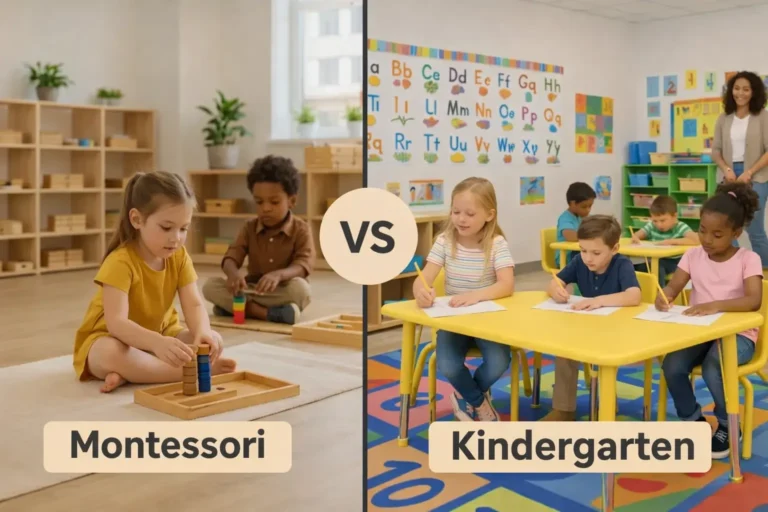
This comparison highlights key differences between Montessori and kindergarten methods. It shows that both approaches are effective in early childhood education but differ in their teaching style and learning focus, by helping the parents and educators to choose the most suitable method for a child’s development.
| Feature | Montessori Method | Kindergarten Method |
| Teaching style | Self-directed learning | Play-based learning |
| Focus | Individual learning and independence | Social, emotional, and group learning |
| Role of teacher | Guide or facilitator | Instructor and play guide |
| Learning materials | Specialized hands-on materials | Toys, games, songs, storytelling |
| Structure | More flexible and child-led | More structured activities |
| Classroom setup | Mixed-age classrooms | Same-age classrooms |
| Main aim | Build independence and practical skills | Develop basic social and cognitive skills through play |
Frequently Asked Questions
A Montessori course is a specialized training program, that teaches how to educate young children using the Montessori philosophy of learning. It prepares the learners with skills to create a child-focused environment where children learn independently through practical, interactive experiences.
Final Thoughts:
The difference between Montessori and Kindergarten is mainly based in their teaching approach, learning style, and structure. Montessori Method focuses on independent, self managed learning with practical activities, whereas Kindergarten Method highlights guided, play based group learning.
To become a certified Montessori educator, you can join MK Educational Training Academy in Chennai for Montessori teacher training. They give international certification, expert guidance, & experimental training to support students build a bright career in early childhood education.